

Blog
Taking a closer look at Nursing
As the next stage of our research commences, we turn our attention to exploring nurses’ experiences of stress, distress and suicidality. Whilst all elements of our study are interested in women nurses’ psychological wellbeing and health, we are taking a closer, in some senses ‘deeper’, look at the everyday experiences of individual nurses.
Exploring the everyday psychological and emotional experiences of women nurses
By: Louise Isham & Hilary Causer
Why explore the ‘everyday’ experiences of nurses?
As the next stage of our research commences, we turn our attention to exploring nurses’ experiences of stress, distress and suicidality. Whilst all elements of our study are interested in women nurses’ psychological wellbeing and health, we are taking a closer, in some senses ‘deeper’, look at the everyday experiences of individual nurses. We also want to understand how nurses make sense of the emotional and psychological demands of nursing and their own sense of their identity as a nurse, over time.
As such, we are now recruiting women nurses to help us address questions like:
How do nurses make sense of their nursing experiences and nursing identity during or after periods of stress and distress?
In what ways do nurses’ experiences of suffering vary in relation to demographic factors, ethnicity and migration history/status and/or their social-cultural identities?
How can institutional practices contribute to nurses’ experiences of suffering?
Recognising the formal and informal ‘work’ of nurses
The study draws on principles of institutional ethnography (Smith, 2005) by recognising that the distinction between formal and informal work is often blurred. The (emotional) skills required of nurses to work in environments that present physical and sometimes psychological risks, is rarely defined as a distinct part of their role. When some aspects of work are not recognised by organisations that work and contribution can feel hidden or silenced, further deepening feelings of isolation and alienation. For our study, expanding the scope of what counts as ‘work’ means understanding the way nursing is shaped by, and spills over into, women’s personal lives. For instance, women’s intimate and family relationships, their domestic and social spaces and their previous histories of caring. In this sense, we recognise that nurses’ personal and professional lives (and identities) are often deeply inter-linked.
What are we going to do?
We have worked in partnership with nurse advisors to design the study. We are using qualitative methods to explore how people think, talk about and make sense of their personal and professional experiences of stress and distress. We are also drawing on ‘creative’ methods in the sense that we are inviting nurses to use diaries and photos to express some of their thoughts and feelings, alongside talking with researchers (and peers). There are two main strands to the study:
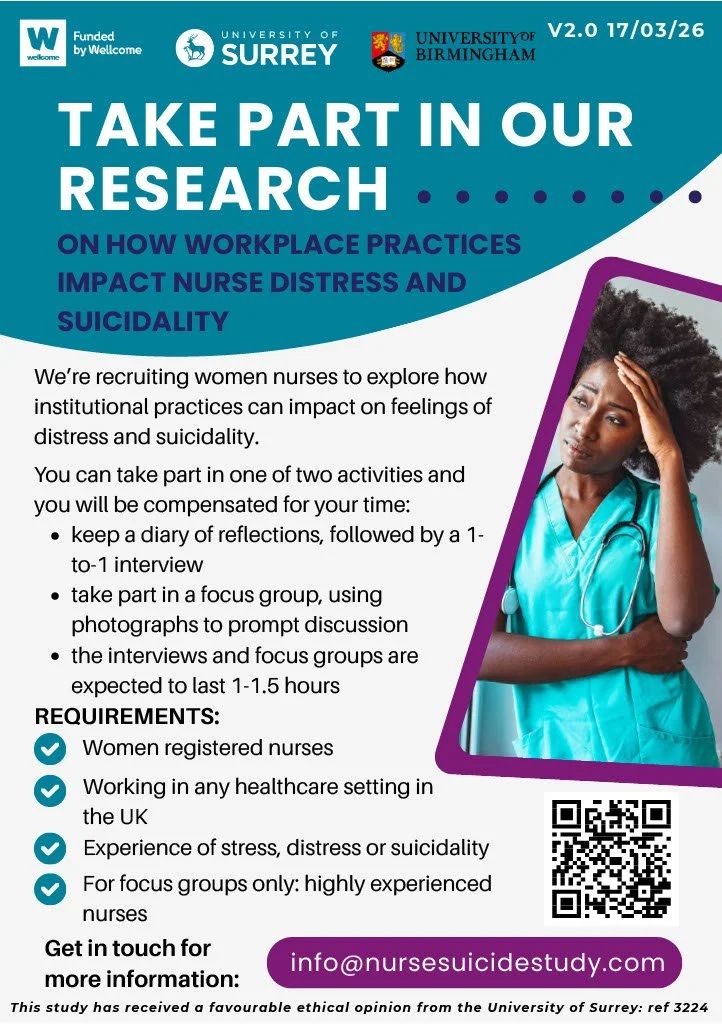
Phase 1: We will ask nurses to complete a short diary for a six-week period, creating at least one diary entry each week. The entries can be written or captured by a quick photo or audio-note – whichever is most convenient and appealing to the individual nurse. Nurses will then be invited to reflect on their diary entries with a researcher in a one-to-one online interview.
Phase 2: We will ask highly experienced nurses to take part in an online group discussion, reflecting on their experiences of nursing and supporting nurses, with a focus on the emotional and psychological dimensions of their work. Nurses will be asked to bring some images or photos to the group discussion to share as part of the discussion.

What is feminist institutional trauma?
We will analyse the data using ideas from feminist institutional trauma (Thompson, 2021). This approach looks at how workplace structures, policies, and organisational culture may contribute to nurses’ higher risk of suicide, rather than focusing only on individual experiences of distress and recovery. For example, we will examine how workplace practices can place too much responsibility and risk on individual nurses, which may affect their psychological wellbeing. We will also consider how factors such as insecure migration status and poor workplace induction can increase stress for internationally recruited nurses.
From this perspective, experiences such as moral distress are recognised as real and important, but they are understood as effects of broader organisational problems rather than simply personal difficulties. Institutional trauma also explores how gender roles and workplace cultures influence organisations, and how these factors interact with issues such as social class, ethnicity, and migration status. This reflects the study’s feminist and intersectional approach, which considers how different forms of inequality and disadvantage can overlap and shape people’s experiences.
Recruiting now
We warmly welcome nurses at any stage of their career, from a diverse range of personal and professional backgrounds, to take part in the diary + interview phase of the study (Phase 1). We also warmly welcome highly experienced nurses to join us for the photo-based discussion groups (Phase 2).
If you are interested in finding out more about this study or what taking part would involve, please contact one of the researchers, Dr Louise Isham (l.j.isham@bham.ac.uk) or Dr Hilary Causer (h.causer@surrey.ac.uk) or see the poster below. We look forward to hearing from you.
References
Smith, D. (2005). Institutional ethnography: A sociology for people. Bloomsbury Publishing PLC.
Thompson, L. (2021). Toward a feminist psychological theory of “institutional trauma”. Feminism & Psychology, 31(1), 99-118. https://doi.org/10.1177/0959353520968374
We are grateful for the support of the Wellcome Trust who have funded this project.
Revisioning the narrative
The theme for this years World Suicide Prevention Day is Changing the Narrative on Suicide. It is a theme that aligns well with the focus of our research on suicide in women nurses. We use the word ‘revisioning’ in the title of our Wellcome Trust funded study to describe our groundbreaking and transformative approach.
By: Hilary Causer, Anna Conolly & Ruth Riley
The theme for this years World Suicide Prevention Day is Changing the Narrative on Suicide.
It is a theme that aligns well with the focus of our research on suicide in women nurses. We use the word ‘revisioning’ in the title of our Wellcome Trust funded study to describe our groundbreaking and transformative approach. Our aim is to revision the way that suicide in women nurses is understood and thought about; to revision our ways of researching by including women nurses through co-production; to revision how we learn by using creative and novel research methods; and to revision how we listen by hearing the experiences of women nurses, and the views and ideas of the public.
Revisioning ways of thinking
We are working with nurses for nurses to revision the ways in which nurse distress and suicidality are articulated and understood. Across our five studies we will be implementing new ways of thinking to help us understand what contributes to personal suffering, distress and suicidality for diverse populations of women nurses. We will be exploring forms of workplace injustices and inequality, and how they operate and affect each other, using a feminist and intersectional approach. As we learn, we will be sharing our knowledge with health sector leaders and policy makers, so that future research and preventative work can incorporate our findings.
Revisioning ways of researching
Co-production with people affected by nurse suicide is central to our work. We consulted nurses as ‘experts by experience’ during the development of the project. Two online consultation exercises helped us to understand nurses’ perspectives on nurse suicidality and we were able to seek nurses’ input on research priorities, questions, design and desired outcomes.
As we progress with our research we are involving a co-production Nurse Advisory Group at every step of our work. We are also seeking further engagement with relevant community groups to ensure input from nurses from international nursing groups, nurse advocates and expert by experience representatives.
Revisioning ways of learning
So far, we have focused on reviewing current academic literature and national and organisational policy documents employing co-design and co-production with women nurses to ensure our research is relevant, ethical and impactful. One of the nurses involved in the critical literature review said:
“I found being involved in the literature review was really interesting and it’s so important for academics to have an appreciation of other people’s knowledge and their lived experience”.
We found that most of the research and policy documents rely on medical models. They explain suicide mainly as the result of mental illness, especially depression. As a result, this research reduces the importance of women nurses’ different experiences and ignores other important factors that may cause distress.
Revisioning ways of listening
In the next stage of our research we aim to explore contexts contributing to suicide in women nurses from the perspectives of nurses working across different settings (e.g. NHS, social care, community, private sector) in the UK. If you are a registered nurse who identifies as a woman working in the UK and would like to contribute to this research, please contact us for more information.
We are holding online focus groups with nurses from October- December 2025 where we will explore your views on factors and contexts which may be contributing to higher rates of suicide in women nurses. We welcome the views and experiences of nurses from underrepresented groups and communities.
Your contribution to this research will help to inform suicide prevention policies which take into account the wide-ranging experiences of women nurses and contexts leading to suicidal distress. The study has received ethical approval from the University of Surrey, (Reference 0347).